
The narrow pass in the process of transformation
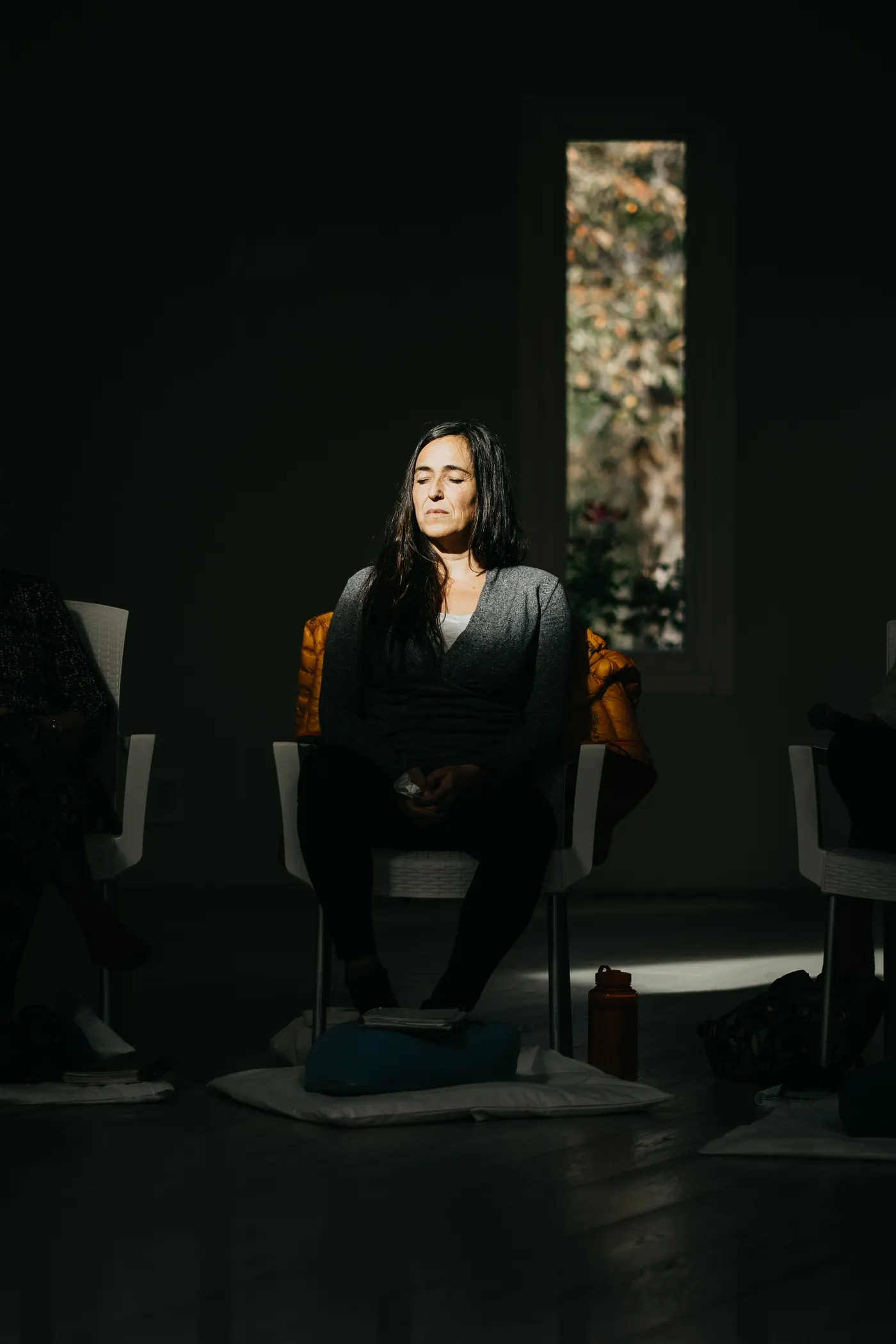
After the autumn retreat, the work has continued in my accompaniment sessions, spaces where we keep exploring what opened up during those days and how it shows up in everyday life. Along this path, we have gone on deepening the image that guided the retreat and that remains our common thread: the leaf we keep in the back pocket of our trousers. As I recounted in the previous article, it emerged in a participant's shamanic journey and showed us in a concrete way the contradiction between the desire to move toward something new and the difficulty of letting go of what we remain attached to.
Although we know we need to let go of it, when we set about doing so we discover how attached we are to it. I have called that moment the narrow pass: a passage that challenges us to go beyond our habitual way of responding and that can give rise to an evolutionary leap in our process of transformation.
The contradiction the image shows us speaks of needs that live side by side within us and that we still do not know how to meet. One part wants to move forward and another tries to protect something that feels threatened by that movement. The tension between the two often becomes an inner struggle, because the more we demand that we change, the stronger the resistance grows and the harder it is to understand what sustains it.
Many of these responses were learned at a time when we depended on others to feel safe and find our place. What helped us adapt then can keep acting when circumstances are already different. The familiarity of a response gives it strength because we know how to move within it and anticipate what is coming, even if it makes us suffer. That is why abandoning a pattern can awaken more fear than continuing to endure its consequences.
Around those adaptations the character is organized: the identity from which we have learned to present ourselves and relate to others. When we are strongly identified with it, if someone makes a remark about our behavior, we may feel it as a disqualification of who we are. Changing then affects our beliefs, our family mandates and the loyalties that sustain our belonging. And, even if we understand that we need to live differently, it is common to feel guilt when taking steps in that direction, as if choosing something different meant betraying the people we love.
The narrow pass confronts us with the tension between keeping a familiar identity and allowing something to develop that we cannot yet sustain. At that point, we need to listen to the resistance, since it holds information about what we fear losing. At the same time, we need to recognize how it limits our life and what consequences it has for others. Understanding its function helps us take responsibility more deeply, without taking refuge in an explanation of why we are the way we are.
Here it is important to develop an adult presence that allows us to accompany the fear of that part of us that keeps responding from childhood trauma, to attend to the need it expresses, and to distinguish what we have lived through from what is happening today, when we already have more resources. In this way we learn to care for our vulnerability and to make decisions that also take into account our bonds, our values and the consequences of our actions.
This work demands attention because the parts are activated before we manage to recognize them, but we can notice them in bodily tension, in the urgency to defend ourselves, or in how our interpretation of a situation becomes rigid. Presence introduces a margin between what we feel and what we do, in which we can listen to different inner positions and keep any single one from taking over the whole experience. Sustaining that tension allows responses to appear that were not available while we remained absorbed by it.
The commitment consists in giving continuity to that capacity when we return to our usual circumstances. An understanding can be deep and still coexist with very deeply rooted responses. For it to transform our way of living it needs practice, repetition and review, since the demands of daily life, the noise and the distractions of the world absorb our attention and easily lead us to respond from familiar patterns without noticing. The work consists in recognizing when we have gone back to acting as before, taking responsibility for what happened and rehearsing another response. In this way, what we have understood in spaces of awareness begins to become a resource we can access in difficult moments too.
To sustain that commitment, it is essential to keep a spiritual practice that allows us to cultivate a different relationship with our experience. Dedicating time to it regularly helps us keep attending to what we discover in our process of transformation, even when everyday obligations absorb our attention. That way we can distinguish between what we fear might happen and what is actually happening, and listen to what we feel without demanding that fear or discomfort disappear as soon as possible. Giving continuity to that practice is a concrete way of caring for the work we have begun.
The archetype of the Master proposes seated meditation: a time to remain in silence, listen to the body and observe what is happening within us. We can also find that practice in prayer, a walk or physical exercise, when we do them with conscious attention. Each person needs to discover which form helps them be present and give it continuity.
In my work, shamanic practice offers another path of exploration. The journey carried out following the rhythm of the drum allows us to access images, sensations and experiences that can broaden our usual understanding. During the Master retreat, the image showed us that, on letting go of the leaf in the pocket, an experience of being torn apart appeared and, afterwards, an image of rebirth, bringing together aspects that still needed to be recognized and worked through.
Its meaning deepens afterwards, as we relate what was lived to our history and recognize how it is reflected in our daily life and in the decisions we need to make. What is interesting is to explore what that loss represents, what feelings it awakens and where the same difficulty appears in our life. Sometimes this involves recognizing what we have destroyed through our unawareness and repairing it as far as possible; at other times, developing capacities that had been set aside by our defenses.
As we attend to what the pattern was protecting, we become less dependent on it. The need for love, safety or belonging is still there, but we begin to find other ways of addressing it and we gradually recover qualities and broaden our capacity to respond. The Master's trust develops in that experience. Then we can see that it is possible to go through a situation without always resorting to the same protection, and to learn from what happens.
The evolutionary leap thus takes on a concrete meaning. We move from being directed by a response we barely recognized to being able to understand it, accompany what it protects and choose how to act. Letting go of the leaf opens possibilities because our life is no longer organized entirely around the effort to keep it. Commitment and practice help us sustain that opening, until what began as an understanding finds expression in our way of living.

Irene GoikoleaDoctor in depth psychology, integral coach and founder of the Amalurra Project. More about Irene


