
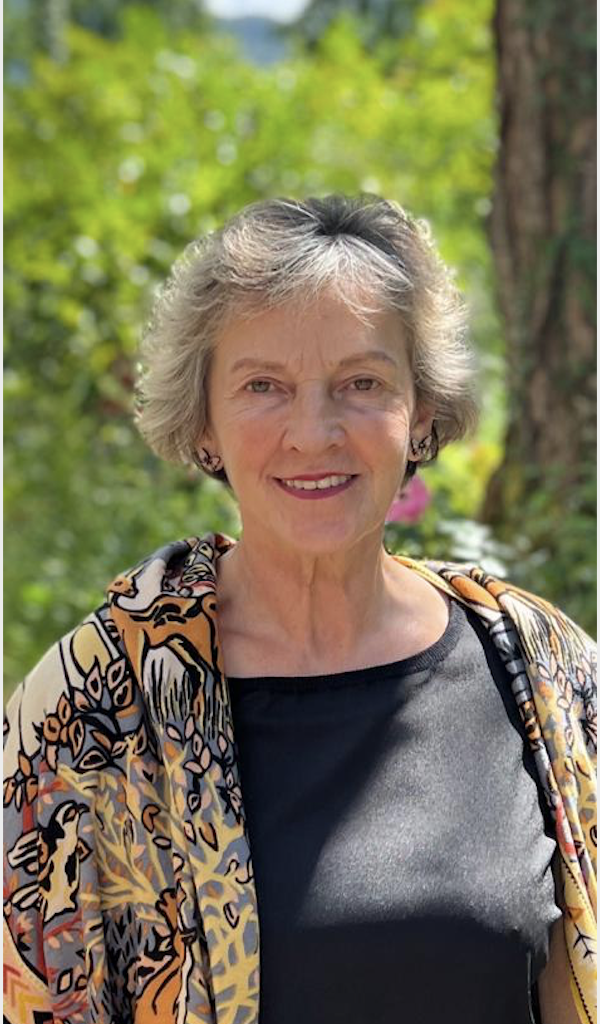




Irene Goikolea Uriarte

Nearly three decades diving and working on my own emotions and accompanying and facilitating many others to do the same, have taught me a way of living and also a way of inhabiting the world. The path I have walked contains a body of knowledge that can help transform the split and limiting perception of our human way of seeing things towards a more holistic and integrative vision of ourselves and our environment.

Throughout my career, I have developed a methodology focused on integration and personal transformation that I have enriched with diverse perspectives, such as the shamanic tradition, Eastern philosophy, the discipline of yoga and depth psychology, without forgetting the wisdom of the ancestral legacy of my Basque roots. I have been in contact with different cultures, which has given me a broadness of vision that continues to stimulate my commitment to diversity.

Also, my commitment to the awakening of the feminine and the impact it has on the development of collective consciousness led me to inspire Amalurra, a project in tune with contemporary movements that promote the development of a collective paradigm, where the culture of the "we" prevails over the culture of the "I".

I am a Doctor of Philosophy in depth psychology from the Pacifica Graduate Institute in Santa Barbara (California). Between July 2017 and July 2019, I was an active member of GEN Europe Council and, since early 2018, I am an ambassador for this organization, a position that qualifies me to represent GEN locally, nationally or internationally. I have been trained in family constellations and new family constellations with Bert Hellinger, systemic rituals with Daan Van Kampenhout, shamanism with Michael Harner, Hakomi, Process Work, Integral Coaching ®, yoga and NLP, among other disciplines.

ICC-IPC Certificate
ICC-IPC Certificate
ICC-IPC Certificate
GEN Europe

1 Intentional Communities: According to C. McLaughlin and G. Davidson, authors of Builders of the dawn: Community lifestyles in a changing world, an intentional community is made up of a group of people who have joined around a common purpose. They share the commitment to cooperate and create a sense of unity together. Such communities can combine the technological advances of the modern times with the values of our tribal roots, as well as a sense of belonging and closeness to others. The purposes of intentional communities vary, from the sharing of resources, the creation of family-oriented neighborhoods to the practice of environmentally sustainable lifestyles (ecovillages). Many intentional communities focus on the importance of living together and sharing life, in contrast to the individualistic trend perceived in Western culture.

FOUNDATIONS OF MY WORK. THE AMALURRA CONCEPT

AMALURRA is the work that I have developed throughout 27 years as a life coach. It is firmly rooted in five basic aspects that I address from a psychospiritual perspective: the awakening to the deep feminine aspect, the power of vulnerability, shadow work, the deep bond with nature and emotional ecology.


DEEP FEMININE ASPECT

The deep feminine aspect, which represents the bond with life, has the gift of sacralizing every daily act, endowing it with will, meaning and feeling. This powerful energy leads us to vulnerability. Its most significant qualities are interrelation, collectivity, integration, unity, caring for the other, healing, nurturing, compassionate action and sentient capacity. Awakening to these qualities enables us to embrace the parts that we exclude from ourselves.

READ MORE.

“More than 27 years ago, in 1993, I began a journey of exploration, self-knowledge and awakening to the deep feminine aspect with a group of women. This first group, which would later be joined by their partners and other people that resonated with my initiative, would become the seed of the Amalurra project. The first encounters, in which unconscious contents rose to the surface easily, were a jolt for all of us. Everything we had rejected emerged in front of us. Later, we would discover that it was not only our own material, but that a part of those unconscious contents was linked to our ancestors and to our society and that they manifested many of the culturally rejected feminine attributes. In fact, according to the research of scholars such as the archaeologist Marija Gimbutas, the deep feminine aspect, present in both men and women, was relegated to the realm of the shadow (the unconscious) with the disappearance of what she called the Goddess civilization (between 7000 and 3000 BC).

The patriarchal system that was subsequently imposed valued mind, reason, materialism, strength, or logic above the feminine attributes of connectedness, the ability to relate, compassion, vulnerability, nurturing, or integration, among others.According to Gimbutas, life was oriented towards consumerism, hedonism and material greed while contact with vulnerability, creativity or the dimension of pleasure, joy or play, as manifestations of the spirit, was repressed. However, the Basque culture would preserve the traditions of the Goddess civilization throughout millennia due to the late arrival of Christianity in the Basque Country, where it did not even reach some mountainous regions.

The main goal of our initial circles was to reconnect with matrilineal consciousness, linked to the Earth's wisdom, the unconscious and vital instincts. This implied getting out of the domination exercised by the negative masculine archetype, as well as by patriarchal mentality, whose basic characteristics are the desire for power, possessions, control, and emotionless contents of consciousness. The first steps we took in order to contact those denied parts occurred when we tried to get out of the self-abandonment in which, in many cases, we had fallen within our couple, family or social relationships. Our intention was to occupy again the place that corresponded to us. The most painful thing was to become aware that we ourselves had renounced our true feelings in exchange for other interests, such as security, image or status. This was the reason why many of us had lost self-esteem and integrity. Our attempt to detach ourselves from those interests brought us into contact with our most buried feelings and emotions.

Standing up required facing our pain for feeling alone or abandoned, as a result of everything that emerged after we had decided to wake up and look into our depths, while taking the first steps towards the much-desired freedom. Once we were consciously ready to feel our vulnerability, we touched wounds whose contents we tended to project mostly on men. It took us a while to realize that they were reflecting us back our own underestimating thoughts towards ourselves. Like them, we had been raised in a patriarchal system. It was obvious that awakening to the deep feminine aspect was not a gender issue. Therefore, in our mixed circles, we tried to approach vulnerability in order to embrace and integrate the feminine and the masculine in each one of us.

This intention was in tune with the spirit of the project; that is, moving towards the balance between the feminine and the masculine energies within the individual, as a stage prior to the integration of the opposites. At first, it was not easy to walk in this direction, as we ran into great unconscious resistance. One part of this resistance came from our personal contents and the other reflected the contents of our people’s cultural unconscious, which comprised the memories related to the traumatic events that the Basque Country has experienced and that, due to their painful nature, we avoided contacting. In this way, we started getting in touch with our feelings and, therefore, with our deep feminine aspect.”

THE POWER OF VULNERABILITY

The target: The Path to our Self.

This approach to personal growth focuses on going beyond our resistance to contact feelings of vulnerability that entail unacknowledged pain. In my work, I distinguish pain from suffering. Pain is a gate to life, while suffering arises from our resistance to feeling pain. Getting in touch with vulnerability also offers the opportunity to recover the dissociated fragments of our soul and get closer to our most genuine self. Recovering the individual soul bonds us to the collective soul or the soul of the world, the anima mundi.

READ MORE.

“The image of a target was the source of inspiration on which I based the inner work processes that sustained the development of the Amalurra project. This figure suggested to me the map of the different layers that, from the surface of the personality, it is necessary to cross to reach the center, the deepest part of the self, where our essence, love or unitary potential lies; that is, LIFE. For me, that center is like a vortex that constantly draws us to itself, thereby manifesting the generosity and genuine love that lie deep within every human being.

In reality, we project outside what we have denied in ourselves and which, therefore, remains in the unconscious. Projection separates us from others and from our surroundings since we tend to see outside what is inside us, as if it were something that does not belong to our reality. This separation fosters a state of suffering to which we become used, but it also creates a thick mental layer that envelops us and disconnects us from our most essential human dimension.

Once we are able to penetrate our thoughts and attitudes, and go beyond them, we arrive at the second layer. There, we can find a psychological fear to contacting the pain that is within our feelings of vulnerability. This fear creates a defense mechanism that keeps us away from what is inside us. It often keeps us even outside of our body and the reality we live in. As a result, we cannot contact our pain nor the life under it. In short, fear prevents us from encountering the fragments of our soul that, due to our pain, remain separated.

The third concentric layer represents pain, which we can touch when we manage to deconstruct everything we had created to avoid the feelings of vulnerability caused by traumatic or overwhelming experiences that were not integrated, especially in our childhood and, in which, in some way, part of our soul was dismembered.

According to Jung, everything that we deny or exclude out of fear of feeling pain forms “the shadow”, whose function is to protect us from the latter. But, while unconscious, the shadow keeps a part of the person separated from their current reality. In this dynamic, the pain remains deeply embedded inside, as an emotional crystallization connected to past experiences that leads us to repeat the patterns originated from a past trauma.

In this way, one does not live in the present, nor can advance to meet the essential part that got separated in the painful experience. By anesthetizing vulnerability, we also anesthetize joy, gratitude or the possibility of being happy; we feel nothing, but we lose our creativity and enthusiasm. In short, we lose life. To recover the life we have lost and become one with our own self, or with the source of love that is within us, it is necessary to penetrate the mental layer that protects it and face the shadow. In this way, we can lift the barrier we had put up and release the accumulated energy, thus healing the damaged area and allowing life to flow again.

Although it may seem so, approaching pain, or the feeling of vulnerability, does not entail suffering. Pain is private and unique and contains information about the fears, prejudices or masks with which we protect ourselves. Going towards it is like going to meet our own blood, because vulnerability brings us closer to our true self. The moment we dare to enter a space of vulnerability that until then had remained barred, and we open ourselves to the feelings it contains, it is as if, suddenly, our house got bigger. Then, life, or the part of our essence that was retained in those feelings that were not integrated, emerges and expands. We are then able to experience, together with those feelings, the joy for their liberation and the love hidden behind them. This liberation positively impacts our health, vitality and joy of living. The cellular alchemy that it fosters has a direct impact on the brain, which will go on to generate new images and possibilities. In fact, neuroscience is showing that the brain’s neural networks reflect, process, and transfer feelings as well as information.

Totally accepting our feelings of vulnerability, or pain, can be considered a spiritual practice that leads us to forgive ourselves and, therefore, to forgive all those we have come across and have mirrored those unconscious contents that we have projected outside. This is how, little by little, we can connect with our most genuine self and access our full potential.”

SHADOW WORK

According to the psychologist C. G. Jung, “the shadow” refers to the parts of the personality that the ego rejects because they do not fit with the ideal image that we have built for ourselves. Shadow work consists of making conscious the contents that are in the unconscious and that, nevertheless, direct many of our actions.

In my workshops, I try to create spaces to look at this dark part, not as something negative, but as an inherent component of every human being, so that we can contain it and, finally, integrate it to turn it into vital and creative energy.

READ MORE.

“Shadow work has been one of the fundamental goals of my work, and an essential foundation in the development of the Amalurra project. The shadow encompasses those aspects of the personality that were not integrated because they did not find a channel of expression, thus hindering the natural flow of life’s current. In order to lift the barriers that prevent that current from flowing naturally, it is necessary to learn to use the qualities and energy of one’s shadow as a positive support towards personal fulfilment.

The shadow originates in the situations in which we could not relate with openness and, consequently, we blocked a vital creative impulse. These impulses are movements eager to follow their evolutionary course. If their natural journey is repressed, a contraction occurs and a fragment of energy is dissociated from our totality. For this reason, the shadow usually keeps a vital part that was hurt, excluded or blocked.

The shadow acts unconsciously through the aspects we project on another person, until we relive the situation that originated it, so as to contact the vulnerability contained in the part that got separated. By means of the mechanism of projection, we try to get rid of our own darkness by dissociating from it and attributing to others what we deny in ourselves, be it laziness, sensuality, cruelty or kindness, among many other aspects. Our most usual reaction is to try to destroy the reflection that puts us in contact with that shadow. For example, although we relegate some thoughts with which we identify, such as, “You are not able to reach your own goals,” “you are useless” or “everyone takes advantage of you,” they will knock on our door again through someone against whom we will react with anger or contempt, unless we can recognize them as the voice of our own shadow, with which we have identified.

Getting to know our true identity implies meeting the shadow, since this is what completes us and makes us human. However, shadow work is one of the most difficult processes we can undertake, as it involves a heart-rending pain and, above all, the destruction of the image that the ego has made of itself.

One of the conclusions I have obtained from the shadow work I have facilitated in the community, as well as in my workshops, is that, whether we deny or identify with it, we remain in a partial version of ourselves. Identifying with the shadow does not allow us to see the light that we also are. Denying it means burying a part of our self. The work consists of learning to look at it, contain it, bear it, integrate it and, finally, take responsibility for what we have destroyed when we have allowed it to act outside our consciousness.

As I have experienced, once the shadow is integrated, the soul fragments that it guards are released and become part of the totality of the individual. The most interesting thing about this process is that the integration of that energy produces an internal balance between the unconscious contents, to which the shadow belongs, and our conscious part. Transforming the unconscious contents into consciousness generates a presence that translates into a greater capacity to contemplate things as a whole, thus benefiting the collective field.

In the same way, I have been able to corroborate that one of the most important challenges on the way towards consciousness expansion is usually accepting the other, the one who opposes us, who reflects what we have rejected and, therefore, what we also are. The work I have done in this regard has shown me that, when we accept what the other reflects us about ourselves, he or she becomes close and the distance that separated us diminishes. Then it is possible to understand that, in the reality of the heart, there is no separation and, despite the apparent opposition, we can see ourselves in the other and recognize ourselves in them.

In short, accepting our human contents gives rise to compassion, which connects us with our intrinsic goodness and allows us to open ourselves to the other, the weak, the foreigner, the outcast. And, once we include them, we can transform what we had rejected, turning it into a source of knowledge. As a result, we can begin to hear the voice of our genuine self and walk more aligned with life.

Regarding the Amalurra project, teaching how to look at and accept one’s own shadow, by reconnecting to the light that it contains, contributed to bringing the necessary maturity for the project to stand up with its own identity, more aware of its limitations and its complexes.”

RECONNECTING WITH NATURE

The Earth reflects the interdependence that exists between human beings, other living species and the planet we inhabit. Recognizing her virtues, generosity and beauty fosters the emergence of a sense of connection and love within the person. Appreciating the beauty of the Earth prepares each one of us to appreciate our inner beauty. Caring for the Earth inspires us to take care of ourselves and of others.

The goal is to try to overcome the individualism of Western culture so that one can feel part of the Earth, which translates into a deeper connection with life. In this vision, ecology becomes as aspect that concerns human beings and in which we have a role to play.

READ MORE.

Connecting with Mother Earth enables us to establish an inner dialogue so that we can communicate with her and open ourselves to receive the teachings of our ancestors, necessary to navigate a time of confusion in which everything seems to be adulterated.

In nature, we find a genuine reference that puts us in contact with our authenticity. Therefore, just as we have fought to defend human rights, I think it essential to recognize and respect the rights of nature until we achieve a form of spiritual or deep ecology that guarantees that every expression of life is venerated. We can no longer consider nature as a commodity or a store of “resources” for our use and benefit, but as a partner and role model in everything we undertake.

It is a proven fact that all beings need a sense of unity and belonging, and nature offers us this bond just like a mother does. Healthy cultures recognize the world as a sacred place and put the needs of the planet before their own. However, over the past centuries, Western culture has become detached from its ancestral legacy and, therefore, from its connection to Mother Earth. It is increasingly difficult for us to remember that we came from her, that we depend on her and that we will return to her.

The global crisis we are going through is an evidence that we no longer feel responsible for the Earth, and not only does this affect us, but also the future generations. We need to understand, from a perspective of humility, that we come from a natural world much greater than our individual and personal selves, from a world that we are obligated to serve.

EMOTIONAL ECOLOGY

More than 27 years ago, I began using the term “emotional ecology” in my lectures and workshops, a personal inspiration on which I based my work. Ten years later, this expression was practically coined as another term in the argot of sciences such as psychology and sociology.

Emotional ecology is based on the premise that inner transformation work contributes to transforming the exterior. From this perspective, the human being is a micro-universe in itself that, in turn, is part of the macro-universe that harbors the Earth and her different social and environmental spheres. The interaction between micro and macro is such that human emotional pollution finds its reflection in environmental pollution and vice versa.

For this reason, the introspection work I promote is aimed at releasing emotions and accessing the feelings we have denied. As we are able to flow in feeling, emotions and thoughts are purified, thus positively affecting our health and, therefore, the environment.

READ MORE.

Being knowledgeable about the emotional world has a projection in both people and the planet’s health. The conflicting emotions we have not managed to solve yet constantly manifest in us through our physical body and the planet’s. To enjoy good health, it is necessary to find a balance between emotions and thoughts, for which it is convenient to carry out a continuous and daily exercise aimed at observing and managing them. Just as the body is physically exercised with perseverance and dedication, we should maintain, with equal persistence and intention, an emotional balance, dealing with the emotions that arise in our lives every day and avoiding “injuries” that can get imprinted in our body tissues.

I am aware that a big part of the degradation that manifests in the external environment originates inside us, in the depth of our emotions. Therefore, I have always supported the activation of our denied feelings so that they can act as the purifying agents of our emotions (human waters) that, in equal proportion to the waters of the Earth, constitute approximately 70% of our physical reality. With human emotions it occurs the same as with water in nature: When it does not flow, it gets stagnated and decomposes. Through a conscious emotional work stagnant waters can find a course to flow, thus favorably impacting the purification of the planet’s waters.

In my opinion, the contaminated and lifeless waters mirror our distancing from our hearts. The polluted air is a reflection of the mind that fabricates in the shadow, separated from the spirit, and the degradation of the Earth speaks of how disconnected we are from our feelings and emotions. Fire, the fourth element, symbolizes the spirit that alchemizes and gestates the ecology of the rest of the elements. This spiritual and holistic perception of ecology ensures that by aligning our emotions we will contribute to cleaning the waters, purifying the air and respecting the Earth. My approach to ecology flows, then, from the inside to the outside, in the certainty that what heals and thrives within oneself will heal and flourish also in the environment.

According to my experience, the consciousness and transformation that are achieved internally contribute to transforming the exterior in the same way that inner harmony creates exterior harmony. However, in everyday life, factors such as fear, pride, shame or pain block up the flow of emotions. Thus, it is important to learn how to remove those obstacles in order to be able to contact vulnerability and let the tears open the floodgates to our restrained emotions. This was the reason that led me to develop a work of introspection aimed at unblocking our emotions and accessing the feelings we had denied since, as we flow in feeling, emotions and thoughts are purified, positively affecting individual health and, consequently, that of the entire planet.